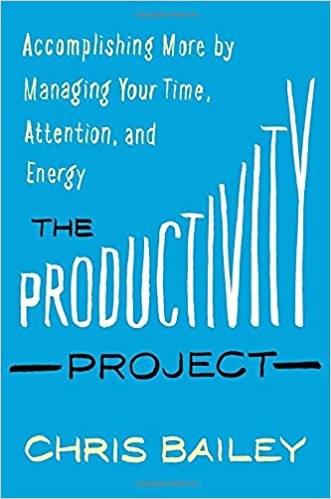
Review: The Productivity Project: Accomplishing More by Managing Your Time, Attention, and Energy by Chris Bailey

Producitvity Project
Go on vacation; read productivity manual. Yeah, that’s me in a nutshell.

I love projects. I love productivity books. And I love the kind of “stunt journalism” that requires writers to do crazy things in the service of writing about it.

Elevator Pitch
The opposite of lazy is not busy. In fact, lazy and busy are quite often synonymous states of being.

Reasons to Read It
I loved that Bailey provided useful tips for productivity in every single chapter. I did some of the challenges he included at the end of each chapter, and I found them quite instructive.

Some reviewers on Goodreads felt that the information he provided was too simple; in contrast, I thought the simplicity of his suggestions made them all the more effective. He’s quite clear that being productive is not that hard. You just have to set goals that lead to bigger goals. But if it were simple, everyone would do it. The complex part is why we don’t just sit down and do it. And the reason for every person is different. 

My reasons for not being as productive as I would like are pretty simple (and kind of embarrassing):

I conflate feeling chaotic and overwhelmed and constantly pulled in a million directions with feelings of accomplishment. That is, if I feel shattered at the end of the day, I feel like I accomplished something. That’s not necessarily true. In fact, it’s often a damned dirty lie that I tell myself. Bailey reminded me that when you slow down, focus, and become more measured, your limbic system goes nuts. Your poor little brain feels underwhelmed. It searches for something flashy to stimulate it. And it tries to convince you that you must be very lazy because how else could you feel so calm? Using your attention and energy wisely is quite frankly such an unusual experience that we don’t know what to make of it.

I assume that taking a break is for quitters. I’ve convinced myself that the best way to do anything is to power through it like a bulldozer, no matter how exhausted my brain is. Yeah, that’s totally wrong. And I know it’s wrong. Productivity is a marathon, not a sprint (though occasionally everyone needs to sprint). This book reminded me that prioritizing regular breaks with focused work sessions is good. It’s not being a wimp.

Ironically, I read the book while I was on vacation. When I started working again this week, I was far more productive than I have been in the past few weeks. The vacation helped me build up energy. And that energy helped me be more focused in my work. And that allowed me to finish things faster. I was tempted to work on vacation, but I didn’t. The experience showed me that I need regular work/writing holidays. My seven-day-a-week work habit is actually costing me time and valuable energy.

Finally, I really appreciated Bailey’s advice to prioritize personal goals, even if it means setting firm boundaries that other people won’t like. That’s something I’ve struggled with a lot at work.  Recently I’ve noticed that my friends with kids are masterful at saying no because they simply have no choice. They have to be home at a certain time, so they can’t stay late for one more meeting. They have to watch kids at certain times of the day, so they can’t check in on email every five seconds. But guess what? They aren’t less productive than I am. They are often more productive. That’s because they have to meet their goals in specified and focused time periods. I just need to learn how to say, “Yeah, I can’t attend one more meeting. I have to go home and eat Fritos while I watch baby monkey videos.” But when I’m not doing that, I need to be focused and fully attentive in regular, measured, and short periods of intense work.

Reasons to Give It the Side-Eye

I know some reviewers scoffed at Bailey because his “conditions” for conducting and applying his productivity research were pretty cushy. He was a recent college grad with no kids and no major responsibilities outside of his productivity work. I understand that critique. I think Bailey gets it too.

I think maybe that’s part of his point: You have to balance your responsibilities with your personal and professional goals to accomplish what you want to get done. You just have to figure out what matters to you. If you have six kids—but you also want to design a model for cold fusion and write a novel in Russian—you are probably going to be able to devote less time, attention, and energy to either your kids or your cold fusion project. And obviously some people have far more resources to balance their lives.

But the critics’ points do stand: It’s easier to be productive when you are privileged.

Worth Reading?
Yes, if only to be reminded that you are probably doing it wrong. After reading the book, I moved back to doing 20-minute writing sessions (followed by a 5-minute break) in 5 or 6 reps. I did more in 3 hours today than I did all of last week. And what I did is actually real stuff—not just fake to-do items. That alone is worth the time it took me to read the book.
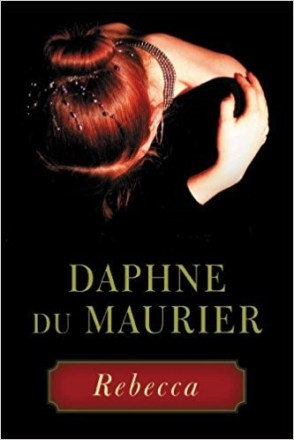

Review: Rebecca by Daphne Du Maurier

Rebecca
Dead wives and plotting housekeepers in a mansion. What more do you need in a book? Nothing is the answer.

Every few years, I get the urge to re-read Rebecca. I know it’s a book that a lot of readers find at an early age, but I didn’t. I was in graduate school the first time I read it upon recommendation of my most readerly friend.

I started it at the laundromat and was so engrossed that I left an entire washing machine full of wet clothes and had to trek back the next day to re-wash a garbage bag of mildew-y clothes. I re-read it about ten summers ago and got so engrossed in it that I barely went outside for a couple of days until I finished. I vowed to read it again after I recently drove past a bus stop near work and saw my friend Ashley immersed in my battered copy—the very copy I’d foisted on her when I heard she’d never read it—while she waited for the bus. Around the same time, I found a nicer copy at a used book shop and decided it was fate. It was time to re-read it. This time around, I vowed to pay attention to what it was that had so captivated me about the book.

Elevator Pitch 
An unsophisticated young girl marries a powerful and mysterious man named Maxim de Winter. She is woefully unequipped to be the mistress of his ancestral estate, and he’s kind of a dick about it. Oh, and the dude’s deceased wife, Rebecca, seems to linger everywhere the narrator turns.

Reasons to Read It

The spooky atmosphere. The first time I read it, I remember loving the suspense. Was Rebecca really dead? Was she a ghost? Was she coming back? Even knowing the twist in the story this time around, I still felt the spooky atmosphere, particularly of Max’s estate, Manderley. I can clearly picture it: a dark, damp manor house somewhere by the sea in England filled with secrets. I’ve never been in such a house, but I can imagine how overwhelming it must feel for the narrator, a girl who hasn’t the slightest idea how to live in such a stately manor (and manner).

The narrator. I love narrators who aren’t immediately likeable or relatable. This unnamed narrator is basically a lump of cold oatmeal. She’s ridiculously naïve and so socially awkward that I sometimes found it uncomfortable being in her head. She’s such a milk sop that she doesn’t even have a name. Rebecca looms large, not just in Maxim’s mind. Nobody can stop thinking and talking about Rebecca. Even wecan’t stop thinking about her because her name shows up on almost every page. Our narrator with the limp hair and the stained dress is so blah and boring that we as readers join her in wondering what in the world Maxim sees in her. But the narrator’s plainness is part of what makes the book so juicy. Why would Maxim marry her? Why is she so terribly awkward? Is she telling us the whole story? Or is she missing key parts of it? Can we trust her? Can we trust her perception of Maxim?

The plot. The overall story is a little rough around the edges, something I didn’t notice the first couple of times I read it. But it still holds up. I’d forgotten how it ended and found myself hoping that the narrator would run off with Frank, Maxim’s agent. (I’ll let you find out if that happens or not.) The point is that even reading it three or four times, I still found the story deliciously dark and twisty. I didn’t forget about my laundry, but I did feel sufficiently swept away.

Reasons to Give It the Side-Eye

A doormat heroine. The narrator has weird daddy issues going on, and she’s not afraid to talk about them. She’s totally willing to be Maxim’s doormat as long as he’ll let her. He doesn’t even have to love her back. She’s content just to be in his presence. She loves him so much it’s kind of embarrassing. As readers, we suspect that he’s with her because she’s the anti-Rebecca, not because he has any real feelings for her. She’s like that person in high school who can’t stop talking about her crush on the guy who “lets” her wash his car and cook him dinner.

One dimensional foes. The Mrs. Danvers character is pretty irredeemable. And it’s really boring and offensive when the might-be-gay character is presented as evil, possibly as a result of her secret love. I know the book was written in 1938, but it would be nice if queer characters (if that’s what Mrs. Danvers is meant to portray) could be presented as fully human.  If anyone ever does an update of the book (and I hope they do), I want Mrs. Danvers to get more depth of character.

Same thing holds for Rebecca. She’s just too bad to be true. After I finished reading the book this time around, I wondered if maybe we are meant to believe that the way Maxim presents Rebecca to the narrator is all part of his borderline personality disorder and his inability to accept Rebecca as she was. (That’s my diagnosis, by the way.)

All of this is to say that the novel needs a good re-visioning. In this new novel, we find out that Maxim is a habitual liar who uses women who are needy enough to marry him. And possibly he ends up with a nasty case of syphilis.

Maxim is a dick. Did I mention that already? It’s hard to swoon over a dude who is this insecure and who essentially marries a child in order to let her take care of him. Ick.

What I Learned (or Re-learned)

Living in a gothic mansion in England is probably really boring and cold. I’d forgotten how many fires had to be lit in the dead of summer. I’d forgotten how many menus had to be approved—how many breakfasts and teas required specific instruction from the mistress of the house. It must be mind-numbing to spend all morning ordering the staff to poach the quail and warm the crumpets. And the social calls! What a nightmare. There’s nothing particularly appealing about being a wealthy society person. It all just sounds boring, but it’s fun to read about.

A good plot is all about pacing and timing.  Du Maurier is really good at carefully doling out little details to keep you wondering and reading. Only upon re-reading was I able to see how masterfully plotted the book is. She’s dropping little clues throughout the novel. And she’s not afraid of letting readers feel uncomfortable as we wait for explanations.

Young me was dumb. The first time I read this book, I was in my mid-20s. But I was still dumb enough to think that a man who needed saving was worth it. I remember thinking that Maxim and the narrator’s relationship was romantic. What? Really? What was I thinking?

Sixteen years later or so, and I cannot for the life of me remember what I ever thought was appealing about their relationship. If I met the narrator now, I’d probably start a Kickstarter for her. She should definitely consider leaving Manderley with her art books and apply for university or get some kind of technical training.

Worth Reading?
Yup, you bet it is. Go do it right now.