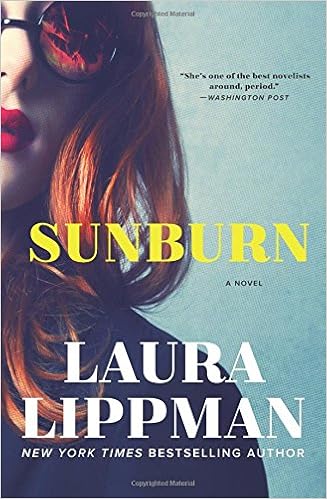
I’ve been reading less this week than last, in part because I’m in the midst of a few large writing tasks. But I did finish two books: The Queen and I and The Last Mrs. Parrish. I liked certain things about both of them, but I have a couple of rants to make, especially about The Last Mrs. Parrish. A review is coming.
I started two more:
And received July’s Book-of-the-Month from my club of one member (me):
June was a lighter summer reading month for me because I went on vacation for ten days and didn’t do much reading at all during that time (save for plane reading). I did, however, read hard before I left town.
I’ve been trying to diversify my reading in terms of genre and publication dates, as well in author identity and nationality. Here’s what June looked like for me:
Publication Dates
4 Published in 2018
3 Published in last five years
1 Published before 2013
Author Identity/Nationality
4 Women
4 Men
6 American
1 Australian
1 Canadian
1 LGBTQ+
Once again, I liked everything I read this month, but I do have superlatives:
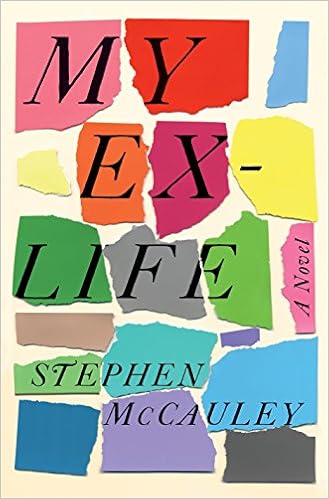
Most Entertaining My Ex-Life by Stephen McCauley
Stephen McCauley has long been one of my favorite authors. If Tom Perrotta, Jonathan Tropper, Anne Tyler, and David Sedaris had a baby, it would be Stephen McCauley.
While this one wasn’t my favorite McCauley (that honor goes to The Easy Way Out), it was just as funny and poignant and generous as everything McCauley writes.
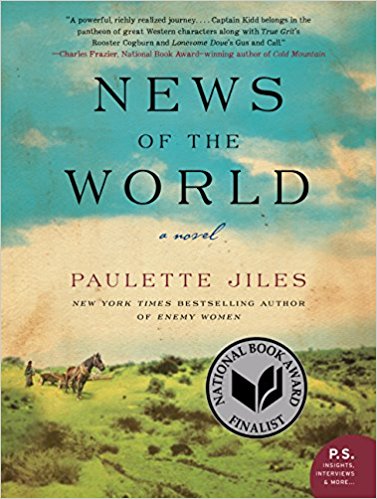
Most Beautiful News of the World by Paulette Giles
I’ve been a fan of Paulette Jiles since Enemy Women. She’s a masterful writer of history. Every character feels honest; every event is rendered with care.
My tagline: Lonesome Dove meets Plainsong
Most Educational A History of Knowledge: Past, Present, and Futureby Charles Van Doren If you’ve ever spent any time thinking about why and how we think now, you really should read this one. Van Doren traces the history of thought from the Pre-Socratics to the late twentieth-century. What he shows is that what we can think–what we know–is largely dependent on the paradigm and standards of the historical time period. As he walks you through history, you get a sense of how knowledge changes. And you begin to see how all the pieces fit together.
Word of Warning: This was was written in the 90s and the last two chapters are hopelessly out of date. Van Doren’s predictions for computers is kind of unintentionally hilarious. And like any book written in a certain time period, his language is sometimes insensitive. I was particularly struck by the section where he calls people who contracted HIV in the ’80s through birth or blood transfusions “innocent,” implying that people who contracted the virus other ways are guilty. Given that the majority of those victims were gay, it’s a pretty egregious use of language.
I’d still recommend this book for armchair historians, especially if you have any interest in the history of science.
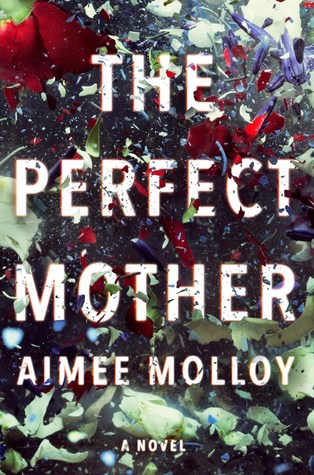
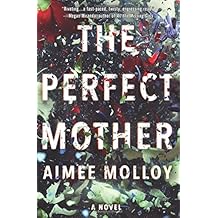
Elevator Pitch: Both books are about mothers who are facing difficult (even tragic) events related to their children, their marriages, and their friendships. Both books feature strong, smart women of means who are grappling with what it means to embrace their identities as mothers without losing themselves. While Hepworth’s book is set in laid-back Melbourne, Australia, and Molloy’s is set in upscale Brooklyn, both authors present characters who are so obsessed with the way they think they ought to be that they fail to see what they’ve become.
My Tagline: All of Liane Moriarty’s books meets a dash of Desperate Housewives meets all of Slate’s coverage of parenting with privilege.
My Opinion: I don’t want to say too much about plot because I think the less you know the better. Both books are heavily plot-driven, but that’s not a criticism on my part. I kept reading because I wanted to know what happened.
Both books are solidly written and structured, with the authors moving back and forth among characters’ perspectives. While both books are about young(ish) mothers, none of them are cardboard cut-outs. All of the characters in both books were finely drawn enough that I didn’t mix any of them up–even though I read the books one after the other.
Hepworth’s book is more thoughtful in that she dives deeper into her characters’ psychological profiles. Because of that, the characters’ behaviors and motivations make more sense. There were times in Molloy’s book that I felt like characters were making decisions because those decisions moved the plot along. I also found the pacing of Molloy’s book a little too slow.
The characters–in both books–are pulled in multiple directions as they try to be everything to everyone. They are also sleep-deprived, anxious, overwhelmed, and confused. I imagine that’s exactly what it feels like to be a new mother. (I’m a nonparent who is far too lazy and far too interested in sleeping and reading to attend to a baby’s needs. Part of the reason I like books like these two is that I get to read about motherhood without having to actually do any of the dirty work.)
Both books present a kind of competitive parenting in certain subcultures that’s deeply performative and self-absorbed. Both books give shape to that, and both authors are sympathetic. Rightfully so. Kids are hard, especially for these women who have complicated lives and deep secrets. Hepworth does a better job of unpacking the unfair cultural expectations of motherhood. Molloy’s feels more banal.
Verdict: I found both books readable and enjoyable, though I like Hepworth’s book much better. I’d recommend it if you’ve blown through Liane Moriarty and want another fix.
Molloy’s felt a little too “beach read” to me, and maybe my mistake was that I didn’t read it on the beach. If you want a quick whodunnit read, this is your book.
For years, I tried never to reread anything. My logic was that there are too many books out there that I haven’t read. I just don’t have time to reread. I’ve recently changed my mind about that. Some of my best reading experiences have been rereads. I’ve also discovered that the only way I like audiobooks is if I’m listening to something I already read and remember well. It’s a lovely experience hearing a beloved book come to life.
Here are two audiobooks that I listen to about once a year:
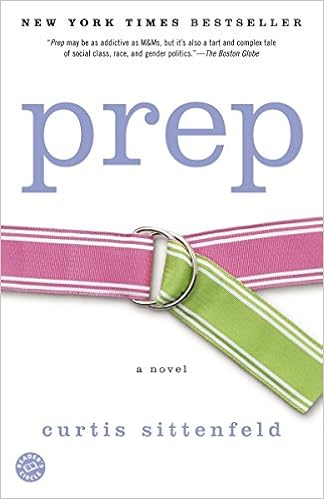
Prep by Curtis Sittenfeld Prep may be in my top five books of all time. I know some people hated it because the main character, Lee Fiora, is such an anxiety-ridden mess whose own self-absorption is the very thing that keeps her from succeeding in her academic life, her family life, and her social life. I totally relate to Lee. Nothing makes you more self-absorbed than an anxiety disorder. That feeling that everyone is watching you–and judging you–is so pervasive that everyday living is excruciating.
I like the audiobook version because the reader sounds young and confused, exactly as I imagine Lee. I like the catharsis at the end, when we fast-forward to Lee’s adulthood, and I am reminded that anxiety doesn’t have to be a death sentence. It’s just an obstacle.
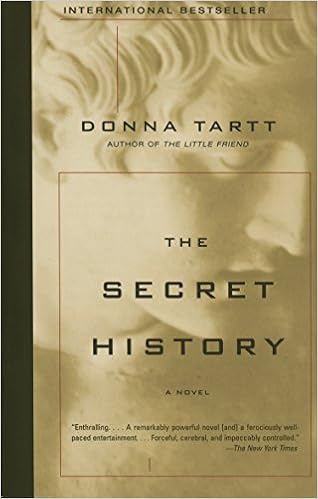
The Secret History by Donna Tartt
A group of clever college students study Greek, drink hard liquor, read the classics, and wax philosophic. Also, they murder their classmate.
Yet the novel isn’t a murder mystery. It’s a dark and twisted tale about how far people will go to save themselves.
I listen to the audiobook because I love the novel, but I have to admit that Donna Tartt would not be my pick for a reader on this one. Her Mississippi accent gets in the way of fully performing New England blue bloods. The narrator of the novel, Richard, is from California, but Tartt makes him sound a little like Jeff Sessions. Go with it.
I know an actual book of the month club exists. I belong to one with only one member: Me.
Once a month–always on the first Saturday of the month–my dear husband looks at my TBR list and selects a book for me. It comes in the mail a few days later, and I get excited every. single.time.
I love being surprised with book mail. I mean, yeah, I pick the contenders, but someone else picks the book. It’s the best of both worlds: I get a surprise, but I don’t have to risk getting a book I’ve already read or one that I’m not really interested in reading.
My personal Book of the Month Club has been running for the last three or four years. My husband has never missed a month, and he’s quite thoughtful about what he picks. If I’m going on vacation, he’ll try to pick something lighter (in terms of content and actual weight.) If I’m on break from school, he’ll pick something heavier and longer.
He’s basically the best husband in the world who knows that all I really want out of life is surprise book mail every now and then.
Elevator Pitch: A bookish girl, Greer Kadetsky, heads off to college and discovers all of the ways the world is sympathetic to men (especially rich white men), often at the expense of women. After meeting Faith Frank, a famous feminist in the vein of Gloria Steinem, Greer devote herself to feminist cause. Greer’s exciting new life upends all of her plans, including her plans with her high school boyfriend Cory, who has an awakening of his own.
My Tagline: Hmm, this is tough because the novel is really quite original. I’d say The Feminine Mystique meets Lean In meets Backlash (with a teeny-tiny dash of The Devil Wears Prada–but just the good parts).
My Opinion: Every once in a while, you come across a book that says things you’ve felt and thought but that you’ve never been able to give voice to. Or that you’ve struggled to arrange in any coherent way. Wolitzer is one of those authors who keenly says all the things you didn’t even know you wanted to say.
The novel itself takes on problems with white feminism and calls out lack of intersectionality. But it also reckons with what that means in a world that’s financed (largely) by old white dudes who, if they even support women’s causes, are far more interested in charismatic and conventionally attractive white women figureheads.
I know some readers were bored or frustrated by the plot. It’s definitely not a plot-driven book, though I think it’s compelling enough. I felt like Cory’s story was muddied Greer’s at times, and I was more interested in her and her relationship with Faith than I was with him. He might have needed his own book, actually.
What kept me reading was the characters, especially Greer. She’s a stand-in for millennial (or post-millennial?) feminists, and I really wanted to see how she would square second-wave feminist with her own views. Ultimately, I think Greer’s conclusion is a little depressing and doesn’t leave a ton of hope for major structural changes, nor does it offer much hope for intersectionality. But I think it’s a pretty realistic portrait of what feminism actually looks like now–and why we need to keep talking about these issues.
Wolitzer points out all the ways that the world is made for men. Here are some of my favorites:
Referring to badly behaved men: “How could men like this even hold their heads up? Yet they did” (277). [Seriously. How do some of the dudes of this world not just die of embarrassment??]
Describing a meeting with men and a woman: “Faith, when she spoke, was perceived as smart and articulate too, but the men felt free to cut in and interrupt her” (282). [Yup.]
Discussing why women are so hard on ourselves: “Faith thought, it’s not that I’m so hard on myself exactly, it’s that I’ve learned to adopt the views of men as if they were my own” (284). [Yup.]
Talking about feminism in general: “She was reminded by older activists that the vanguard had to be extreme so that the more moderate people could take up the cause and be accepted” (287). [I’d never thought of it this way before.]
Describing privileged men: “Men like him romped through the world, and it wouldn’t be possible to take away his sense of freedom or security” (300). [I’d like to romp.]
Writing about the things men “let” women do: “Men give women the power that they themselves don’t want” (325). [So true. ]
Questioning what it means to be a “good” girl: “Good girls could go far, but they could rarely go the distance. They could rarely be great” (352). [Definitely. Being a “good girl” is not a goal.]
Verdict: Definitely read it if you are interested in feminism. It would make a great high school or college graduation gift, in fact.
If you loved Wolitzer’s other books, I think you’ll like this one too. My favorite remains The Wife.
Elevator Pitch: Ani FaNelli has a secret, but she’s not going to let that stop her from getting the life of luxury she wants. She’s going to marry a blue blooded New Yorker, continue working at a glamorous women’s magazine, carry designer handbags, and make you so jealous of her perfect life that you’ll want to weep. But what if her past collides with her present?
My Tagline: Speak by Laurie Halse Anderson meets Sex and the City
Genre: I’m going to call it contemporary fiction. I found it on a psychological thriller list, and I don’t think that’s a good fit. It’s definitely not cotton candy, either. So let’s just call it fiction.
My Opinion: It’s hard to find novels that deal responsibly and authentically with issues surrounding consent. I love that Knoll isn’t afraid to write a character who is angry, oftentimes unlikable, and brutally honest with readers about who she is (even if she isn’t honest with anyone else in her life).
While it isn’t a YA novel, I think it gets at important issues in ways that are more complex, more nuanced, and more mature than you might find in YA lit. It would pair well with Speak.
Verdict: Buy it. You’ll want to give it to someone else in your life, preferably a mature young adult reader.
Elevator Pitch: Crappy husband plans exciting vacation day for his hot wife with a bad digestive system. Psychological thrills ensue.
My Tagline: Sleeping with the Enemy meets Anthony Weiner
My Opinion: I love a good unreliable narrator, and Paul Strom is pretty unreliable. He’s also arrogant and socially clueless, which makes him an even more interesting character. You know he’s up to something, but you’ll keep reading to find out what it is.
Paul’s wife, Mia, is wholly sympathetic. (Of course, I would think that: I too have been in a relationship a Paul Strom.) But Mia throws a few curveballs that will make you wonder if you really know her at all.
Verdict: Borrow it from the library when you have an entire weekend to read it in big gulps. Pairs well with sweatpants and slippers.
Dead wives and plotting housekeepers in a mansion. What more do you need in a book? Nothing is the answer.
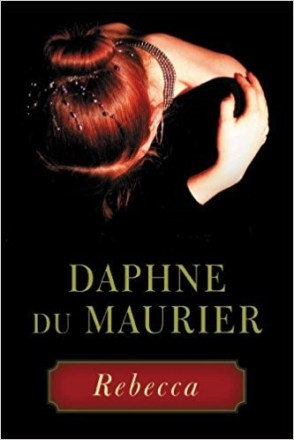
Every few years, I get the urge to re-read Rebecca. I know it’s a book that a lot of readers find at an early age, but I didn’t. I was in graduate school the first time I read it upon recommendation of my most readerly friend.
I started it at the laundromat and was so engrossed that I left an entire washing machine full of wet clothes and had to trek back the next day to re-wash a garbage bag of mildew-y clothes. I re-read it about ten summers ago and got so engrossed in it that I barely went outside for a couple of days until I finished. I vowed to read it again after I recently drove past a bus stop near work and saw my friend Ashley immersed in my battered copy—the very copy I’d foisted on her when I heard she’d never read it—while she waited for the bus. Around the same time, I found a nicer copy at a used book shop and decided it was fate. It was time to re-read it. This time around, I vowed to pay attention to what it was that had so captivated me about the book.
Elevator Pitch
An unsophisticated young girl marries a powerful and mysterious man named Maxim de Winter. She is woefully unequipped to be the mistress of his ancestral estate, and he’s kind of a dick about it. Oh, and the dude’s deceased wife, Rebecca, seems to linger everywhere the narrator turns.
Reasons to Read It
The spooky atmosphere. The first time I read it, I remember loving the suspense. Was Rebecca really dead? Was she a ghost? Was she coming back? Even knowing the twist in the story this time around, I still felt the spooky atmosphere, particularly of Max’s estate, Manderley. I can clearly picture it: a dark, damp manor house somewhere by the sea in England filled with secrets. I’ve never been in such a house, but I can imagine how overwhelming it must feel for the narrator, a girl who hasn’t the slightest idea how to live in such a stately manor (and manner).
The narrator. I love narrators who aren’t immediately likeable or relatable. This unnamed narrator is basically a lump of cold oatmeal. She’s ridiculously naïve and so socially awkward that I sometimes found it uncomfortable being in her head. She’s such a milk sop that she doesn’t even have a name. Rebecca looms large, not just in Maxim’s mind. Nobody can stop thinking and talking about Rebecca. Even wecan’t stop thinking about her because her name shows up on almost every page. Our narrator with the limp hair and the stained dress is so blah and boring that we as readers join her in wondering what in the world Maxim sees in her. But the narrator’s plainness is part of what makes the book so juicy. Why would Maxim marry her? Why is she so terribly awkward? Is she telling us the whole story? Or is she missing key parts of it? Can we trust her? Can we trust her perception of Maxim?
The plot. The overall story is a little rough around the edges, something I didn’t notice the first couple of times I read it. But it still holds up. I’d forgotten how it ended and found myself hoping that the narrator would run off with Frank, Maxim’s agent. (I’ll let you find out if that happens or not.) The point is that even reading it three or four times, I still found the story deliciously dark and twisty. I didn’t forget about my laundry, but I did feel sufficiently swept away.
Reasons to Give It the Side-Eye
A doormat heroine. The narrator has weird daddy issues going on, and she’s not afraid to talk about them. She’s totally willing to be Maxim’s doormat as long as he’ll let her. He doesn’t even have to love her back. She’s content just to be in his presence. She loves him so much it’s kind of embarrassing. As readers, we suspect that he’s with her because she’s the anti-Rebecca, not because he has any real feelings for her. She’s like that person in high school who can’t stop talking about her crush on the guy who “lets” her wash his car and cook him dinner.
One dimensional foes. The Mrs. Danvers character is pretty irredeemable. And it’s really boring and offensive when the might-be-gay character is presented as evil, possibly as a result of her secret love. I know the book was written in 1938, but it would be nice if queer characters (if that’s what Mrs. Danvers is meant to portray) could be presented as fully human. If anyone ever does an update of the book (and I hope they do), I want Mrs. Danvers to get more depth of character.
Same thing holds for Rebecca. She’s just too bad to be true. After I finished reading the book this time around, I wondered if maybe we are meant to believe that the way Maxim presents Rebecca to the narrator is all part of his borderline personality disorder and his inability to accept Rebecca as she was. (That’s my diagnosis, by the way.)
All of this is to say that the novel needs a good re-visioning. In this new novel, we find out that Maxim is a habitual liar who uses women who are needy enough to marry him. And possibly he ends up with a nasty case of syphilis.
Maxim is a dick. Did I mention that already? It’s hard to swoon over a dude who is this insecure and who essentially marries a child in order to let her take care of him. Ick.
What I Learned (or Re-learned)
Living in a gothic mansion in England is probably really boring and cold. I’d forgotten how many fires had to be lit in the dead of summer. I’d forgotten how many menus had to be approved—how many breakfasts and teas required specific instruction from the mistress of the house. It must be mind-numbing to spend all morning ordering the staff to poach the quail and warm the crumpets. And the social calls! What a nightmare. There’s nothing particularly appealing about being a wealthy society person. It all just sounds boring, but it’s fun to read about.
A good plot is all about pacing and timing. Du Maurier is really good at carefully doling out little details to keep you wondering and reading. Only upon re-reading was I able to see how masterfully plotted the book is. She’s dropping little clues throughout the novel. And she’s not afraid of letting readers feel uncomfortable as we wait for explanations.
Young me was dumb. The first time I read this book, I was in my mid-20s. But I was still dumb enough to think that a man who needed saving was worth it. I remember thinking that Maxim and the narrator’s relationship was romantic. What? Really? What was I thinking?
Sixteen years later or so, and I cannot for the life of me remember what I ever thought was appealing about their relationship. If I met the narrator now, I’d probably start a Kickstarter for her. She should definitely consider leaving Manderley with her art books and apply for university or get some kind of technical training.
Worth Reading? Yup, you bet it is. Go do it right now.



 My Ex-Life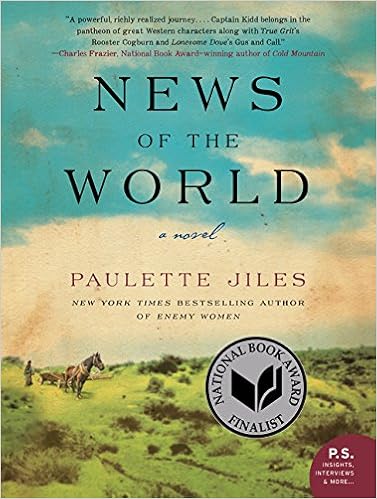
 If you’ve ever spent any time thinking about why and how we think now, you really should read this one. Van Doren traces the history of thought from the Pre-Socratics to the late twentieth-century. What he shows is that what we can think–what we know–is largely dependent on the paradigm and standards of the historical time period. As he walks you through history, you get a sense of how knowledge changes. And you begin to see how all the pieces fit together.
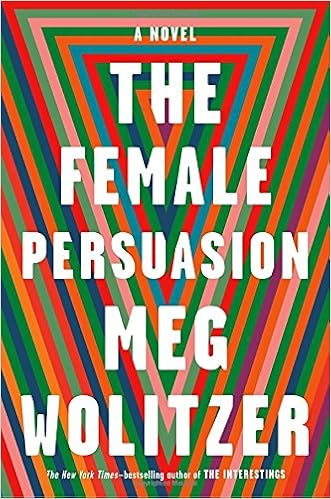 Elevator Pitch: A bookish girl, Greer Kadetsky, heads off to college and discovers all of the ways the world is sympathetic to men (especially rich white men), often at the expense of women. After meeting Faith Frank, a famous feminist in the vein of Gloria Steinem, Greer devote herself to feminist cause. Greer’s exciting new life upends all of her plans, including her plans with her high school boyfriend Cory, who has an awakening of his own.
 Elevator Pitch: Ani FaNelli has a secret, but she’s not going to let that stop her from getting the life of luxury she wants. She’s going to marry a blue blooded New Yorker, continue working at a glamorous women’s magazine, carry designer handbags, and make you so jealous of her perfect life that you’ll want to weep. But what if her past collides with her present?
 Christine Seifert