Currently Reading

I’ve been reading less this week than last, in part because I’m in the midst of a few large writing tasks. But I did finish two books: The Queen and I and The Last Mrs. Parrish. I liked certain things about both of them, but I have a couple of rants to make, especially about The Last Mrs. Parrish. A review is coming.

I started two more:


And received July’s Book-of-the-Month from my club of one member (me):

On Writing

I’m working on my next book. It’s (loosely) about WWII, the French Resistance, and women who participated in the war, at home and in occupied areas. I have stacks of nonfiction, but I want some good fiction to put in a WWII mindset. What are your favorites?

Filling Reading Gaps

We all have a list of books we’ve wanted to read–or felt we should read–that we just haven’t gotten to. I have a zillion of them.

But here’s one I just got from the library that I’ve never read.

Murder, games, and mayhem? Yes, please.

To be totally honest, I hadn’t heard of the book until Liberty Hardy, my reading hero, mentioned it multiple times the All the Books podcast. I must fill this reading gap immediately!


Holidays Are for Reading

I’m going to start lying when people ask me what I’m doing for a holiday. If I answer honestly—that I’m going to sit on my patio, read a book, and enjoy the breeze, and when I’m done with that I’m going to sit on my couch and read a book, and then I’m going to go to bed and read a book—a lot of people seem to feel sorry for me.

“Oh,” someone sadly said to me this week, “that’s too bad you don’t have any fun plans for the Fourth of July.”

The truth is I would rather read than do just about anything else. I’m not sad at all that I’m taking a miss on parades, barbecues, concerts, and fireworks. I’m right where I want to be. I have two books on the docket:


The Queen and I by Sue Townsend
I loved Sue Townsend’s Adrian Mole series, so I grabbed this one at a library sale while on vacation. It’s a clever satire about the British Royal Family who have been forced out of the monarchy and into real life. Hilarity ensues.

The Last Mrs. Parrish by Liv Constantine
This one is a wicked suspense novel that feels like a Lifetime movie in all the best ways. It’s compelling, but it’s not brain-taxing in the slightest.

Happy Fourth of July. May your day be free of parades.


What I Read: June 2018

June was a lighter summer reading month for me because I went on vacation for ten days and didn’t do much reading at all during that time (save for plane reading). I did, however, read hard before I left town.

I read eight books in June:

To Explain the Word: The Discovery of Modern Science by Steven Weinberg
My Ex-Life by Stephen McCauley
The Family Next Door by Sally Hepworth
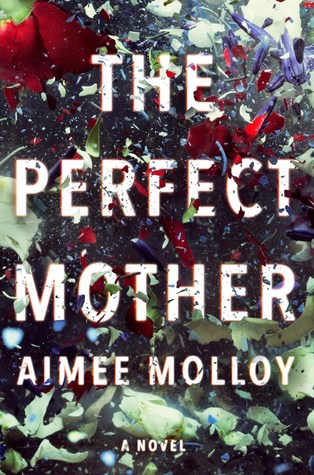
The Perfect Mother by Aimee Molloy
News of the World by Paulette Giles
The Immortalists by Chloe Benjamin
Voices in the Ocean: A Journey Into the Wild and Haunting World of Dolphins by Susan Casey
A History of Knowledge: Past, Present, and Future by Charles Van Doren

I’ve been trying to diversify my reading in terms of genre and publication dates, as well in author identity and nationality. Here’s what June looked like for me:

Genre 
4 Contemporary Fiction
1 Historical Fiction
3 Nonfiction

Publication Dates
4 Published in 2018
3 Published in last five years
1 Published before 2013

Author Identity/Nationality
4 Women
4 Men

6 American
1 Australian
1 Canadian

1 LGBTQ+

Once again, I liked everything I read this month, but I do have superlatives:

Most Entertaining
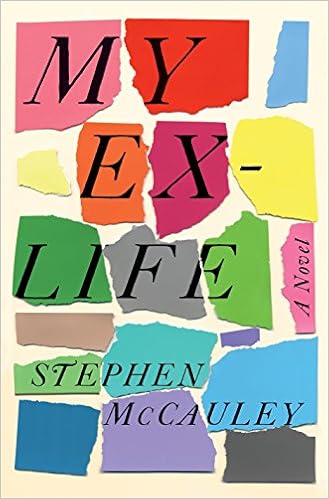
My Ex-Life by Stephen McCauley
Stephen McCauley has long been one of my favorite authors. If Tom Perrotta, Jonathan Tropper, Anne Tyler, and David Sedaris had a baby, it would be Stephen McCauley.

While this one wasn’t my favorite McCauley (that honor goes to The Easy Way Out), it was just as funny and poignant and generous as everything McCauley writes.

Most Beautiful
News of the World by Paulette Giles 
I’ve been a fan of Paulette Jiles since Enemy WomenShe’s a masterful writer of history. Every character feels honest; every event is rendered with care.

My tagline: Lonesome Dove meets Plainsong

Most Educational
A History of Knowledge: Past, Present, and Future by Charles Van Doren
If you’ve ever spent any time thinking about why and how we think now, you really should read this one. Van Doren traces the history of thought from the Pre-Socratics to the late twentieth-century. What he shows is that what we can think–what we know–is largely dependent on the paradigm and standards of the historical time period. As he walks you through history, you get a sense of how knowledge changes. And you begin to see how all the pieces fit together.

Word of Warning: This was was written in the 90s and the last two chapters are hopelessly out of date. Van Doren’s predictions for computers is kind of unintentionally hilarious. And like any book written in a certain time period, his language is sometimes insensitive. I was particularly struck by the section where he calls people who contracted HIV in the ’80s through birth or blood transfusions “innocent,” implying that people who contracted the virus other ways are guilty. Given that the majority of those victims were gay, it’s a pretty egregious use of language.

I’d still recommend this book for armchair historians, especially if you have any interest in the history of science.

Happy Reading in July!


Review: The Family Next Door by Sally Hepworth and The Perfect Mother by Aimee Molloy

Elevator Pitch: Both books are about mothers who are facing difficult (even tragic) events related to their children, their marriages, and their friendships. Both books feature strong, smart women of means who are grappling with what it means to embrace their identities as mothers without losing themselves. While Hepworth’s book is set in laid-back Melbourne, Australia, and Molloy’s is set in upscale Brooklyn, both authors present characters who are so obsessed with the way they think they ought to be that they fail to see what they’ve become.The Family Next Door

My Tagline: All of Liane Moriarty’s books meets a dash of Desperate Housewives meets all of Slate’s coverage of parenting with privilege.

My Opinion: I don’t want to say too much about plot because I think the less you know the better. Both books are heavily plot-driven, but that’s not a criticism on my part. I kept reading because I wanted to know what happened.

The Perfect MotherBoth books are solidly written and structured, with the authors moving back and forth among characters’ perspectives. While both books are about young(ish) mothers, none of them are cardboard cut-outs. All of the characters in both books were finely drawn enough that I didn’t mix any of them up–even though I read the books one after the other.

Hepworth’s book is more thoughtful in that she dives deeper into her characters’ psychological profiles. Because of that, the characters’ behaviors and motivations make more sense. There were times in Molloy’s book that I felt like characters were making decisions because those decisions moved the plot along. I also found the pacing of Molloy’s book a little too slow.

The characters–in both books–are pulled in multiple directions as they try to be everything to everyone. They are also sleep-deprived, anxious, overwhelmed, and confused. I imagine that’s exactly what it feels like to be a new mother. (I’m a nonparent who is far too lazy and far too interested in sleeping and reading to attend to a baby’s needs. Part of the reason I like books like these two is that I get to read about motherhood without having to actually do any of the dirty work.)

Both books present a kind of competitive parenting in certain subcultures that’s deeply performative and self-absorbed. Both books give shape to that, and both authors are sympathetic. Rightfully so. Kids are hard, especially for these women who have complicated lives and deep secrets. Hepworth does a better job of unpacking the unfair cultural expectations of motherhood. Molloy’s feels more banal.

Verdict: I found both books readable and enjoyable, though I like Hepworth’s book much better. I’d recommend it if you’ve blown through Liane Moriarty and want another fix.

Molloy’s felt a little too “beach read” to me, and maybe my mistake was that I didn’t read it on the beach. If you want a quick whodunnit read, this is your book.

Rereading With Audiobooks

For years, I tried never to reread anything. My logic was that there are too many books out there that I haven’t read. I just don’t have time to reread. I’ve recently changed my mind about that. Some of my best reading experiences have been rereads. I’ve also discovered that the only way I like audiobooks is if I’m listening to something I already read and remember well. It’s a lovely experience hearing a beloved book come to life.

Here are two audiobooks that I listen to about once a year:

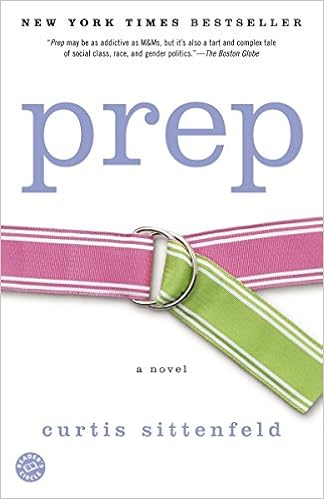
Prep by Curtis Sittenfeld
Prep may be in my top five books of all time. I know some people hated it because the main character, Lee Fiora, is such an anxiety-ridden mess whose own self-absorption is the very thing that keeps her from succeeding in her academic life, her family life, and her social life. I totally relate to Lee. Nothing makes you more self-absorbed than an anxiety disorder. That feeling that everyone is watching you–and judging you–is so pervasive that everyday living is excruciating.

I like the audiobook version because the reader sounds young and confused, exactly as I imagine Lee. I like the catharsis at the end, when we fast-forward to Lee’s adulthood, and I am reminded that anxiety doesn’t have to be a death sentence. It’s just an obstacle.

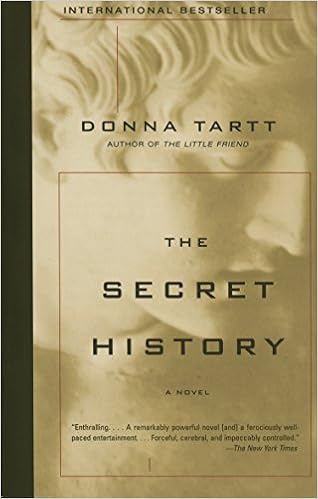
The Secret History by Donna Tartt
A group of clever college students study Greek, drink hard liquor, read the classics, and wax philosophic. Also, they murder their classmate.

Yet the novel isn’t a  murder mystery. It’s a dark and twisted tale about how far people will go to save themselves.

I listen to the audiobook because I love the novel, but I have to admit that Donna Tartt would not be my pick for a reader on this one. Her Mississippi accent gets in the way of fully performing New England blue bloods. The narrator of the novel, Richard, is from California, but Tartt makes him sound a little like Jeff Sessions. Go with it.

Reading on Planes

One of my favorite things about air travel is turning off my devices. I know I could put my phone in airplane mode any time I want. I don’t. I allow myself to be distracted, largely by things I don’t care about.

But on a plane, I’m held captive. I can’t access anything because I’m too cheap to pay for wifi. I can be alone with books for as long as the plane is in the air, assuming I can signal to my seatmates that I don’t want to talk. That can be challenging since I attract talkers. (Case in point: I recently went to New Mexico and the cab driver asked me if I wanted to see her house. I thought it would be rude to say no. So I got to ride past her house where she showed me her new porch ottoman. Very lovely.)

The point is that planes are a great space for good reading, assuming you can ignore everyone around you and don’t mind being seated in a manner that must be the most clinically uncomfortable position known to humans. I like to take books that require a lot of concentration because I know that it’s either the book or talking to the guy in a Make America Great hat next to me. I’ll focus on the book.

I’m traveling this week, and I’m bringing A History of Knowledge: Past, Present, and Future by Charles Van Doren.

If you don’t hear from me again, I’m trapped under a stranger’s ottoman.

Books That Take Time to Love (or Appreciate)

Have you ever read a book that you initially didn’t like–or even hated–and then you later realized your initial opinion was all wrong?

It happens to me fairly regularly. I think that’s because I’m a slow thinker. One of my wonderful colleagues once told me there are two kinds of thinkers: microwaves and crock-pots. She identifies as the latter; that is, someone who needs to simmer for a long period of time. It takes longer, but it’s so much richer. Microwaves can zap for thirty seconds and walk away with something fully cooked, but that food is never as good.

Here’s a list of four books that I initially didn’t like, until I put the crock-pot on simmer for a few years until my ideas were fully cooked.

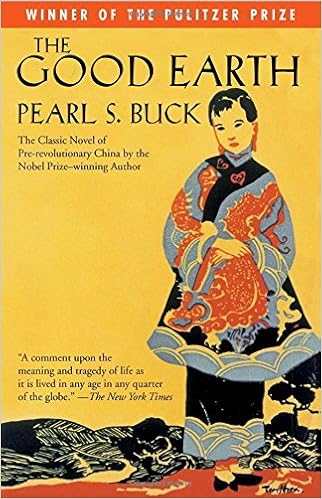
The Good Earth by Pearl S. Buck
I read this for the first time in college and thought it was boring. I later re-read it, just for fun, and realized I was totally wrong. My initial response was complete disdain for the wife, O-Lan, because I wanted her to stand up for herself. Only after simmering did I realize that O-Lan’s selflessness is the only power she has. As a younger reader, I often fell into the trap of judging characters by second-wave feminist values.

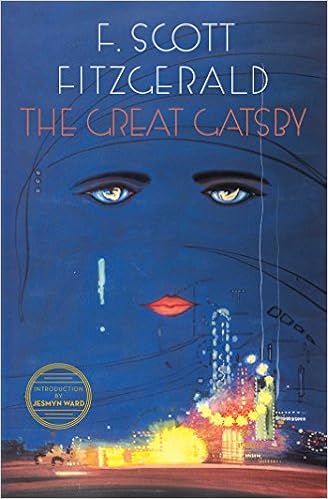
The Great Gatsby by F. Scott Fitzgerald
I read this in high school and it totally went over my head. I think that’s because, without even realizing it, I bought into the American Dream, that old canard that largely exists to serve the hegemony. I read it again in college and got closer to understanding. I read it yet again for a book club a few years ago and finally got something: This is the Great American Novel because it captures the essence of an empty culture that has built itself on false exceptionalism and gross consumption. And like most novels of its time, its attitude toward women and its toxic masculinity is on full display.

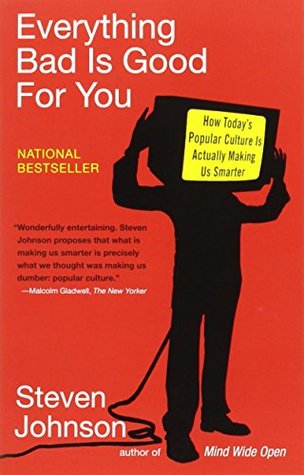
Everything Bad is Good for YouEverything Bad Is Good for You by Steven Johnson
Johnson’s argument is basically that TV (and other forms of entertainment that we’ve long considered mindless) is getting more and more challenging, both in terms of the critical thinking required and in terms of the narrative structure. I had trouble fully buying that argument until I taught a short class on pop culture where we used Johnson’s methods to analyze TV and video games from the 70s/80s and from recent years. Johnson is right: Pop culture as a whole is way smarter and far more rewarding. There’s still plenty of dumb stuff out there if you want it, but pop culture isn’t a wasteland.

Forever Amber by Kathleen Winsor Forever Amber
I unfairly dismissed this as a romance novel. (Not that there’s anything wrong with romance novels. Just that I categorized it as one that didn’t have much substance.) I was wrong. This is a fantastic historical novel about Restoration England. I read it twice and then gave a copy to my grandmother who told me that she’d read it years ago, back when it was released in 1944. It was considered a “sexy” novel back then, but it’s as good of a history lesson about the time period as you’ll ever get. Now I want to read it again.